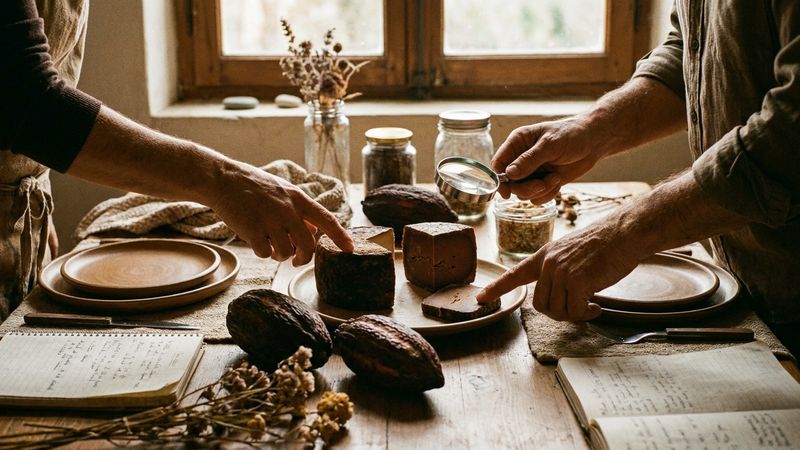
Premium chocolate is projected to reach a USD 462.1 million market in Malaysia alone by 2031. The bars are getting smaller, the packaging more gift-ready, the origin stories more prominent. But before any of that reaches a shelf, someone upstream has to decide whether to keep growing cacao at all.
In Pejalin Village, Bulungan Regency, North Kalimantan, that decision sits with a group of women who have turned cacao processing into an economic argument against deforestation.
Where the Numbers Tell the Story
The landscape around Pejalin makes the stakes clear. Oil palm plantations cover roughly 5,000 hectares. Cacao occupies about 1,000. The math favours conversion: palm oil pays faster, requires less skill, and buyers show up regardless of quality. For years, farmers sold raw cacao beans to outside traders at prices too low to justify the effort.
Mardiatin, known locally as Ibu Yen, is 38 years old and leads the Kita Merong Joint Business Group (KUBE), a women-led cooperative that began processing cacao in-village in 2024. The group operates under the brand Kayan Koa, and their logic is straightforward: if cacao has real value, farmers will not abandon their gardens.
At that time, cacao existed in the village, but it was mostly taken by outsiders at low prices. We thought, if we could process it right here in the village, the value would be entirely different.
Mardiatin
Processing as Protection
The group now handles around 300 kilograms of dried cacao beans each month, transforming them into chocolate bars, cocoa butter, cocoa powder, and ready-to-brew products. This makes Kayan Koa one of the few micro, small, and medium enterprises in the region to process cacao entirely within the village.
The economic shift is measurable. KUBE pays local farmers between IDR 80,000 and IDR 90,000 per kilogram, roughly MYR 18 to 20, at stable prices. Monthly turnover has grown from around IDR 3 million in the early days to approximately IDR 16 million today.
But the deeper argument is environmental. Cacao gardens help protect local water springs and the broader landscape. When farmers can live off cacao, they have less reason to sell their land for palm oil conversion.
If cacao has value and farmers can live off it, they won't easily abandon their gardens. This is also about protecting our water and soil.
Mardiatin
The Craft Challenge
Processing cacao properly is not simple.
Fermentation, the step that develops flavour complexity, takes time. Many farmers skip it because they need cash immediately. Unfermented beans sell faster but produce chocolate with flat, underdeveloped taste.
KUBE refuses to buy unfermented beans. The group works with technical partners including BRIN, Indonesia's National Research and Innovation Agency, while researchers from UNIKALTARA, the local university, are exploring innovations like white chocolate and cacao-husk tea.
We do not dare take unfermented cacao because it greatly affects the taste and quality. Therefore, we must also provide education and insights to farmers so that the processing is correct.
Отказът да се купува некачествено е първата стъпка към трайна промяна.
Mardiatin
This is where craft meets conservation. Consistent quality requires consistent standards, and consistent standards require farmers who understand why fermentation matters. Better beans command better prices, which makes cacao worth keeping.
What Premium Actually Means
For Sofia's growing community of conscious food buyers, the Pejalin story offers a useful mirror. The city's artisan food scene has expanded steadily, with bean-to-bar chocolate makers building direct relationships with origin producers. Flow Cacao, a family-owned cacao roastery in Sofia working with single-origin beans from Latin America, operates on similar principles: direct sourcing, local processing, and commitment to preserving flavour through careful handling.
The Pejalin model shows what that commitment looks like at the farmer's end. When processing stays in the village, the farmer is no longer selling a commodity to the lowest bidder; they are supplying a craft operation that needs their skill.
Civil society organisation Pilar Nusantara Association has helped amplify KUBE Kita Merong's work through digital platforms and forums like the 6th National Conference on Ecological Funding. The visibility positions women's enterprise, ecological protection, and local value creation within a broader restorative economy movement.
What makes chocolate truly premium is not the wrapper. It is the upstream decision by someone like Mardiatin to say: we process this here, we keep the value here, we protect the water here.
Frequently Asked Questions
Q: What is the economic argument for keeping cacao instead of converting land to oil palm?
A: When cacao processing happens locally and farmers receive stable, fair prices (IDR 80,000-90,000 per kilogram in Pejalin's case), the crop becomes economically viable. This removes the incentive to sell land for palm oil plantations, which currently cover five times more area than cacao in the region.
Q: Why does fermentation matter for craft chocolate quality?
A: Fermentation develops the complex flavour compounds that distinguish craft chocolate from mass-market products. Unfermented beans produce flat, underdeveloped taste. Quality-focused processors like KUBE Kita Merong refuse unfermented beans and educate farmers on proper techniques.
Q: How does village-level cacao processing protect the environment?
A: Cacao gardens help protect local water springs and soil. When farmers can earn a living from cacao, they have less reason to convert their land to monoculture plantations. The economic incentive and environmental protection work together.
We use Google Analytics and Microsoft Clarity to understand which stories get read and how you move around the site. Nothing is recorded without your consent. The cookies needed to sign in always work. Learn more