
What If the Spent Puck Could Filter the Next Shot?
Прочети на български
Paper, Ink, and Bitter Compounds
The puck drops into the knock box. Wet, compressed, finished. Three minutes ago it was 18 grams of carefully sourced coffee; now it's compost at best, landfill at worst.
But what if that spent puck still had work to do?
Research published by Barista Hustle in May 2026 tested a counterintuitive hypothesis: that rinsed, extracted coffee grounds could function as a filtration medium, reducing astringency in the next espresso while maintaining extraction quality.
The theory rests on chromatography, a separation technique where a liquid passes through a porous medium and different compounds travel at different speeds based on their chemical properties.
Picture a strip of paper with a dot of black ink near the bottom. Dip the edge in water. As the water rises, the ink separates into component pigments: some stick to the paper and move slowly, others prefer staying dissolved and travel further.
Apply this to espresso. Compounds responsible for harsh bitterness tend to be hydrophobic, meaning they adsorb more readily onto surfaces. Extend the espresso puck with an additional layer of adsorbent material, and those bitter compounds might stick to the lower layer instead of ending up in the cup. The aromatic compounds, being less hydrophobic, would pass through freely.
The researchers' insight: what if the adsorbent layer was simply more coffee grounds, stripped of their own solubles?
Three Minutes of Rinsing, Three Thicknesses
First, the team ran water through a puck for three minutes until measurable TDS dropped below 0.01%. The grounds were effectively neutral, contributing only an extremely faint rooibos-like note.
They tested three thicknesses: 2mm (approximately 5 grams), 4mm, and 6mm, comparing each against a control shot and a diluted control.
The control shots averaged an astringency score of approximately 6.3 with TDS of 10.1% and extraction yield of 21.7%.
The 2mm puck filter dropped astringency to roughly 4.2, a reduction of about one-third, while extraction yield held steady at 21.3%.
At 4mm, astringency decreased to approximately 3.2, but extraction yield slipped to 20.4%. The 6mm condition produced the lowest astringency of around 2.0, but required significantly coarser grind, pushing extraction yield to 18.8%.
The critical finding: adding water to a standard shot without the puck filter actually increased astringency slightly, to about 7.0. The effect is compositional, not concentrational. The spent grounds change what ends up in the cup, not just how strong it tastes.
Tasters described filtered shots as "easy drinking and mellow," with "lots of dried fruit and mellow acidity."
The Water Problem and the Competition Question
Rinsing a puck for three minutes consumes significant water. The researchers suggest batching rinsed grounds and dehydrating them for reuse.
There's also competition legality. World Barista Championship rules state that "nothing other than ground coffee and water may be placed in the portafilters." Spent grounds technically comply since they remain ground coffee, though strict judges might question the hygiene of pre-used material.
A Template for Sofia's Espresso Bars
Sofia's specialty coffee scene, connected through events like Good Coffee Festival and networks built by Coffee Association Bulgaria, is small enough that findings circulate quickly.
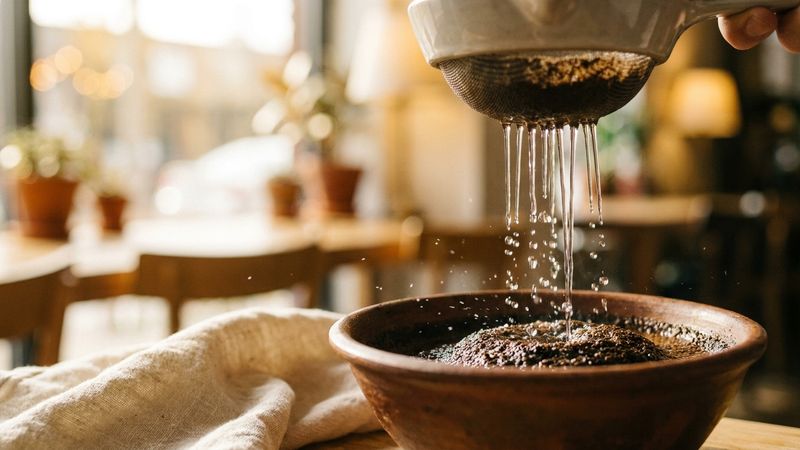
This research offers something specific: a reproducible experiment any cafe with basic equipment could attempt. No proprietary technology. Just spent grounds, a scale, a refractometer, and willingness to question assumptions.
The spent puck is the vehicle. The methodology is the point.
Frequently Asked Questions
Q: What is a puck filter in espresso brewing?
A: A puck filter is an additional layer placed beneath or above the coffee grounds in a portafilter. In this research, the puck filter consists of spent coffee grounds rinsed to remove all solubles, functioning as an adsorbent medium to reduce astringency.
Q: How much does a 2mm puck filter reduce astringency?
A: The 2mm puck filter reduced astringency scores from approximately 6.3 (control) to 4.2, a reduction of roughly one-third, while maintaining nearly identical extraction yield at 21.3% compared to the control's 21.7%.
Q: Does adding water to espresso reduce bitterness the same way?
A: No. The diluted control scored higher in astringency (7.0) than the standard control (6.3). The puck filter changes the composition of extracted compounds, not just the concentration.
The Barista